
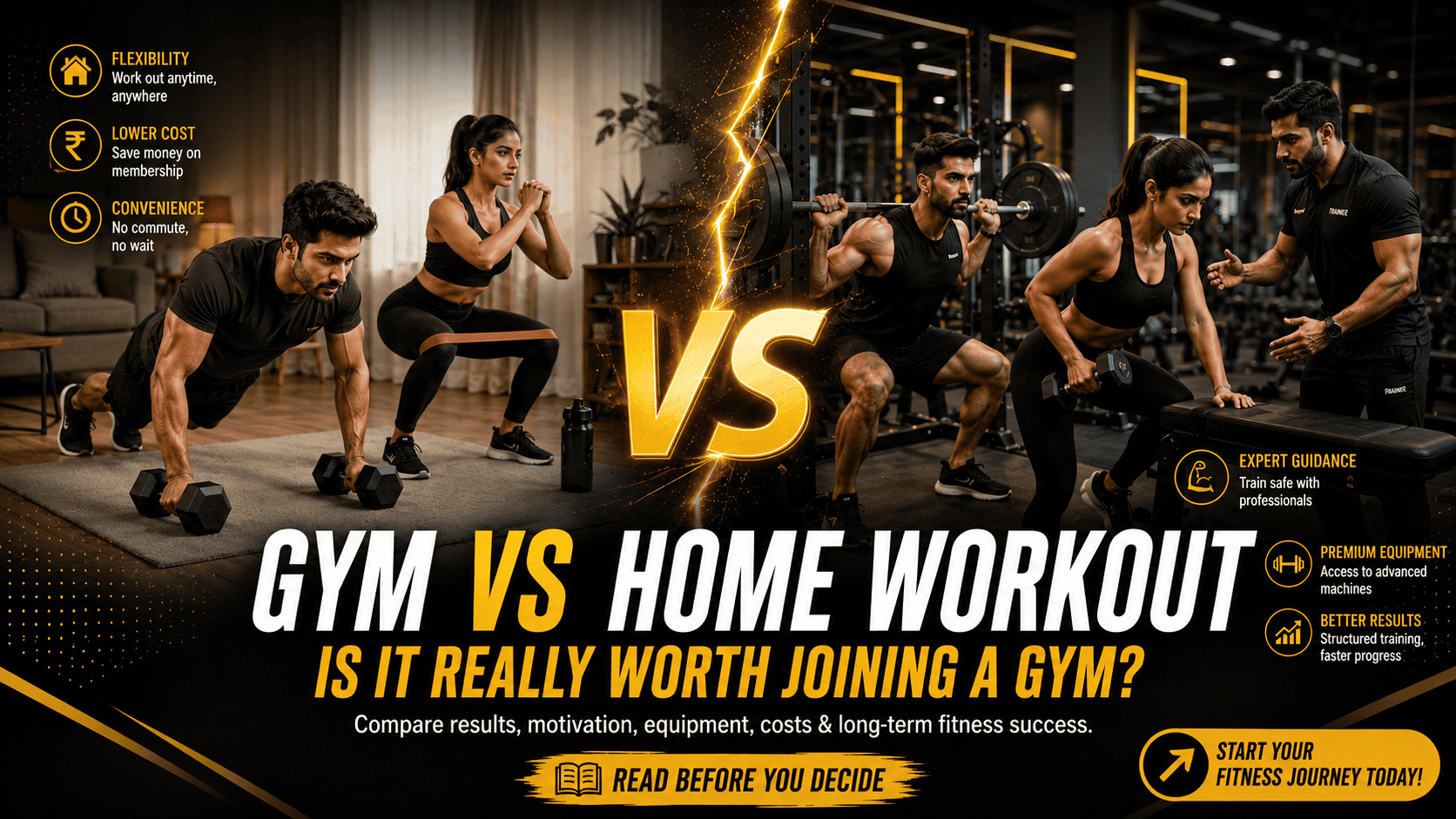
You’ve probably had this exact debate with yourself at least once.
You open a fitness app, watch a few home workout videos, and think — “Why pay for a gym membership when I can just do this at home for free?” Then a week later, the motivation disappears, the mat gets folded into a corner, and you’re back to square one.
This is one of the most common questions in fitness, and honestly, there’s no one-size-fits-all answer. It depends on your goals, your discipline, your space, and what actually keeps you consistent. Let’s break it down properly — no fluff, no bias — so you can decide what’s genuinely worth it for you.
Gym vs Home Workout: Quick Comparison
Short answer: A gym is generally worth it if you want structured progress, access to proper equipment, and expert guidance — while home workouts work best for people who are already disciplined, have basic equipment, and prioritize convenience over facilities. Most people see faster, more consistent results at a gym simply because it removes daily decision-making and distractions.
Here’s how the two actually compare, factor by factor:
When it comes to equipment access, a gym gives you the full range — machines, free weights, and cardio equipment — while a home workout limits you to whatever you already own. Cost works differently for each: a gym involves a monthly or annual membership fee, whereas home workouts are largely free or low-cost once you’ve made the initial equipment purchase.
Motivation also tends to be higher at the gym, simply because the environment pushes you to perform, while working out at home demands a lot more self-discipline to stay on track. When it comes to guidance, a gym offers trainers who correct your form and plan your progress, while home workouts are usually self-guided or app-based. Convenience swings the other way — the gym requires travel time, but a home workout means zero travel and the freedom to train anytime.
The Real Cost Comparison: Gym Membership vs Home Equipment
People assume home workouts are automatically cheaper. That’s only half true.
Gym membership costs typically include:
- Monthly or annual membership fee
- Access to all equipment and machines
- Group classes (Zumba, HIIT, yoga, etc.)
- Trainer guidance included or available at low extra cost
- Locker rooms, showers, and hygiene facilities
Home workout costs usually include:
- Dumbbells, resistance bands, or a bench (one-time cost, but adds up for a full setup)
- A phone or laptop for workout apps/videos
- Optional: protein supplements, a yoga mat, home cardio equipment (treadmill/cycle, which is expensive)
If you want a home setup that even comes close to a basic gym — dumbbells of varying weights, a bench, a barbell, resistance bands, and maybe a cardio machine — the one-time cost can easily exceed a full year of gym membership. Gyms simply spread that cost across all members, which is why memberships tend to feel more affordable long-term.
Which One Gives Better Results — Gym or Home?
This depends entirely on two things: your goal and your discipline level.
If Your Goal Is Weight Loss
Both can work, but a gym gives you access to varied cardio equipment, structured HIIT classes, and trainers who adjust your plan as you progress — which usually means faster, more sustainable fat loss.
If Your Goal Is Muscle Building
This is where Best Fitness Gym In Saibaba colony clearly win. Progressive overload — gradually increasing weights — is much harder to achieve at home without a full range of dumbbells, barbells, and machines. Bodyweight training has a ceiling; strength equipment doesn’t.
If Your Goal Is General Fitness or Flexibility
Home workouts (yoga, bodyweight circuits, mobility routines) work perfectly fine here, since intensity and equipment matter less.
If Your Goal Is Consistency
This is the deciding factor for most people, and it’s rarely about the workout itself — it’s about whether you’ll actually show up. A gym membership, a scheduled class, or a booked trainer session creates external accountability that home workouts don’t naturally have.
Why Most People Struggle to Stick to Home Workouts
It’s not laziness — it’s environment. A few reasons home workouts commonly fail long-term:
- No fixed schedule: “I’ll do it later” quietly becomes “I’ll do it tomorrow”
- Constant distractions: Family, chores, deliveries, notifications
- No one holding you accountable: Skipping a home workout has zero visible consequence
- Workout fatigue: Doing the same YouTube video repeatedly gets boring fast
- Limited progression: Once bodyweight exercises get easy, there’s often no next step without equipment
None of this means home workouts don’t work plenty of disciplined people train effectively at home. It just means the environment does a lot of the heavy lifting when it comes to consistency, and a gym environment is built specifically to support that.
Why a Gym Might Be Worth It For You
- Structured programs: Trainers build a plan around your specific goal instead of generic routines
- Correct form guidance: Reduces injury risk, especially with weights
- Variety: Machines, free weights, cardio equipment, and classes keep workouts interesting
- Accountability: A scheduled gym visit is harder to skip than a home session
- Community: Being around other people working toward similar goals is genuinely motivating
- Faster progression: Access to a full range of weights means you’re never “stuck” at your current level
When Home Workouts Actually Make More Sense
- You travel frequently and can’t commit to a fixed gym schedule
- You’re extremely self-disciplined and already know proper form
- Your goal is light maintenance, flexibility, or stress relief rather than serious strength or fat-loss progress
- You genuinely can’t access a gym nearby
- You prefer a hybrid approach — training at home on some days and at the gym on others.
Distractions are another factor: Gyms naturally have fewer household distractions, whereas working out at home often means dealing with family, chores, phone notifications, or the TV. The social element also differs a gym offers community and accountability, while home workouts can feel isolated and are far easier to skip. And finally, progress tracking is far more structured at a gym, with programs and trainer feedback, compared to home workouts, which are usually self-tracked and often inconsistent.
Gym vs Home Workout: Which Should You Choose?
Quick answer: If you want faster results, proper guidance, and long-term consistency, a gym is generally worth the investment. If you’re highly disciplined, have basic equipment, and your goals are light-to-moderate, home workouts can work — but most people find it harder to stay consistent without the structure a gym provides.
A useful way to decide: ask yourself honestly how many home workouts you’ve actually completed in the last 30 days versus how many you planned. For most beginners, that gap is exactly why a gym ends up being the better long-term investment — not because home workouts don’t work, but because the gym environment removes the daily battle of motivation


